

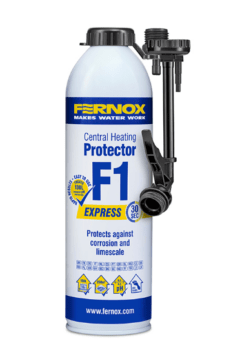
What Is Central Heating Inhibitor?
Central heating inhibitor is a liquid chemical treatment formulated to stop internal metal corrosion, scale, and black sludge build-up in a sealed heating system.
- It forms a protective passivation layer across internal steel, cast iron, and copper components, neutralising dissolved oxygen and chemical reactions that degrade heat exchangers, valves, and radiators.
- It operates strictly as a preventative measure; it will not clear heavy existing sludge blockages, repair pipework leaks, or act as a substitute for standard boiler repairs.
- A qualified Gas Safe registered engineer should test system water concentration during routine annual servicing and correctly dose the circuit via a magnetic filter, towel rail, or filling loop vessel when required.
What Does Inhibitor Protect Inside the System?
Inhibitor passivates internal metallic surfaces to prevent mixed-metal corrosion and stop non-aerated water forming heavy black magnetite sludge.
- Steel radiators: Prevents localised pitting corrosion, pinhole leaks, and lower-section cold spots caused by settling iron oxide debris.
- Copper pipework: Minimises galvanic reaction rates at solder joint interfaces and brass valve connections across the wet pipe circuit.
- Aluminium heat exchangers: Regulates system pH balance to prevent acidic chemical etching, a vital check carried out during an annual boiler service.
- Mixed-metal corrosion risk: Suppresses micro-galvanic currents that naturally form when circulating heating water acts as an electrolyte between dissimilar metals.
How Does Central Heating Inhibitor Work?
Central heating inhibitor works through chemical passivation, pH stabilisation, and microscopic particle dispersion to protect primary pipework. Once injected into circulating water, it forms an active molecular film over internal metal surfaces, halting reaction pathways that generate iron oxide. Simultaneously, chemical buffers stabilise water pH to prevent acidic attack on heat exchangers. Rather than breaking down heavy accumulated sludge, it keeps minor debris suspended for continuous filtration during system operation.
- Protective layer on metal surfaces: Anodising and cathodising chemical agents bind to exposed copper, steel, and iron, halting oxidative erosion.
- pH buffering: Maintains circulating water alkalinity within an optimal 7.5 to 8.5 pH band to suppress chemical attack across components.
- Particle dispersion: Surfactants keep microscopic corrosion particles suspended for magnetic filter capture, unlike restorative magnacleanse flushing which clears dense deposits.
Corrosion, Scale, and Sludge Mechanisms
Internal central heating system degradation stems from three distinct physical and chemical mechanisms: active metallic corrosion, mineral limescale precipitation, and black sludge accumulation.
- Corrosion: Oxygen reacting with steel components triggers ongoing electrochemical oxidation, deteriorating internal radiator walls and generating fine microscopic iron oxide particles throughout circulating system water.
- Limescale: Thermal breakdown of hard water causes dissolved calcium and magnesium minerals to precipitate, forming hard insulating deposits inside boiler primary heat exchangers.
- Sludge: Heavy black magnetite forms when oxidised metallic debris settles in low-flow radiator zones, which proper dosing prevents alongside a magnetic filter installation to capture continuous circulating particles.
Signs Your Heating System Needs Inhibitor
Observable performance faults often signal poor water quality, but physical symptoms act as diagnostic indicators rather than definitive proof of low chemical protection.
- Cold radiator bottoms: Heavy magnetite sludge settles in lower channels, restricting circulation across the panel.
- Boiler noise: Scale deposits inside the heat exchanger restrict flow, causing localised kettling and gurgling.
- Bleeding radiators: Discharging dark water or hydrogen gas during venting signals active internal chemical corrosion.
- Slow warm-up times: Circulating debris restricts pipework, delaying heat distribution to peripheral radiators.
- Repeated pressure or flow-related issues: Suspended particles foul pumps and diverter valves, causing circulating flow restrictions.
An engineer must test inhibitor concentration and verify total system condition first, as heavy debris requires a chemical system flush.
Inhibitor vs Cleanser vs Biocide vs Leak Sealer
Central heating chemical treatments serve distinct, non-interchangeable functions within a wet circuit, making correct product selection essential for maintaining continuous system protection.
- Inhibitor: Delivers continuous corrosion protection against internal metal degradation, scale, and sludge formation, functioning strictly as a preventative chemical barrier rather than a cleaning agent.
- Cleanser: Mobilises loose iron oxides, grease, and installation flux prior to chemical dosing, frequently applied during a central heating flushing service to clear circulating debris.
- Biocide: Controls bacterial growth, microbiological slime, and fungal contamination, specifically targeting low-temperature circuits such as underfloor heating loops where heat fails to sterilise.
- Leak sealer: Encapsulates microscopic weeping joints or tiny pinhole weep points, serving exclusively as a temporary seal rather than a permanent structural pipework repair.
How a Heating Engineer Adds and Tests Inhibitor
Achieving effective chemical protection relies on calculating total system water volume accurately, dosing to precise inhibitor concentration levels, and verifying chemical stability using physical testing methods.
- Calculate system volume: Calculate total system water volume by assessing radiator counts and pipework capacity to prevent under-dosing.
- Ensure safe access: Confirm circuit temperature is cool and depressurise the system safely prior to introducing chemicals.
- Inject chemical treatment: Dose via an inline magnetic filter, towel rail, or dedicated dosing vessel depending on pipework layout.
- Bleed and re-pressurise: Complete radiator bleeding to eliminate trapped air pockets and restore working system pressure.
- Circulate system water: Operate central heating pumps to distribute the treatment evenly across all radiators and heat exchangers.
- Test and record: Check final inhibitor concentration and water pH using laboratory-grade test kits, logging details on the benchmark commissioning record during a routine boiler service.
Standards, Warranty, and Safety Rules
Applying central heating inhibitor in accordance with British Standards and manufacturer instructions ensures regulatory compliance, protects component safety, and preserves valid boiler warranties.
- BS 7593:2019: Mandates the code of practice for preparing, cleaning, and chemically treating water in domestic wet heating circuits to protect system efficiency.
- Manufacturer instructions: Major manufacturers specify chemical dosing and annual concentration checks to maintain boiler protection, making this vital during a new boiler installation.
- Gas Safe registered engineer: Work requiring combustion checks, casing removal, or boiler servicing must be performed by a qualified Gas Safe registered engineer.
- COSHH compliance: Chemical handling requires adherence to COSHH guidance and safety data sheets, with dosing details logged on the benchmark warranty record.
Frequently Asked Questions
| What is central heating inhibitor and why do UK heating systems need it? Central heating inhibitor is a chemical treatment added to a sealed UK heating loop to reduce corrosion, scale, and magnetite sludge. It is not a substitute for power flushing a heavily contaminated system. |
| How does central heating inhibitor work inside a sealed heating system? Central heating inhibitor works by helping to form a protective layer on metal surfaces, buffering system water pH, and keeping fine corrosion particles dispersed so they can be captured by a magnetic filter.” |
| How much inhibitor does a typical UK home heating system need? A typical UK home with 8 to 12 radiators may hold around 80 to 130 litres of water. Many inhibitors are dosed at approximately 1 litre per 100 litres, but the engineer should calculate system volume and follow the product data sheet. |
| Will central heating inhibitor fix cold radiators or a noisy boiler? Not always. Central heating inhibitor can help prevent future corrosion and sludge formation, but cold radiator bottoms, kettling, or boiler lockouts may require a system cleanse, filter service, pump diagnosis, or Gas Safe inspection. |
| Is central heating inhibitor required for boiler warranty or Gas Safe compliance? Gas Safe registration is required for gas boiler work, while inhibitor dosing is part of system water treatment. Many boiler warranties and BS 7593:2019 expect a clean system, correct inhibitor concentration, and proper commissioning records. |

EXCELLENT Based on 8 reviews
 Posted on Google
 James6 October 2026Great service, quick booking and visit. Sent the certs same day. Recommended.Posted on GoogleSamara6 July 2026Great service, reasonable pricing, got the job done extremely quick, nice lad, very professional and cleaned up after himself, absolutely would recommendPosted on GoogleDainora27 May 2026I had a boiler issue, stopped working. He arrived on the same day and ensured that the boiler works while we wait for parts. Kept me updated while parts were coming and asked if the boiler is still working. Always kept the area clean and explained what was the issue. Great job! Definitely recommend.Posted on GoogleAdrian18 May 2026Fantastic service from Guy, who travelled out to Market Rasen on a Sunday when our boiler stopped working. He was super professional, quick to sort the issue, and great value for money. With kids in the house, getting the heating and hot water back on meant everything, definitely one of those luxuries you take for granted until they’re gone. Really appreciate the effort and would highly recommend.Posted on GoogleAnnette29 March 2026Guy came to us today which was a wet and cold Sunday afternoon as my Elderly Mother was without heating. After initial contact a time was agreed and Guy arrived on the dot.... He was very good and explained everything he was doing ensuring we understood what was happening. Guy was very clean and there was not a single bit of mess left behind. He made sure we were happy with the work and didnt leave until he was 100% sure the problem was fixed. There was no hard sell with Guy at all he explained a few options for us in the future. Would HIGHLY reccommend Guy and have saved his details for future use. 5☆☆☆☆☆Posted on GoogleDavid20 March 2026Thank you very much for servicing my boiler and balancing my radiators. All working well again. Highly recommended.Posted on GoogleJames10 March 2026Was polite and tidy. Fixed an issue with our central heating and fitted a new bathroom radiator. Thanks

Questions? Contact us

Serving customers in Grimsby, Cleethorpes, Immingham, Louth, Brigg, Caistor, Market Rasen, Barton upon Humber and Scunthorpe.
