The Verdict: Is the Worcester Bosch 1000 Worth the Money?
Yes, the Worcester Bosch 1000 is an excellent entry-level option if you need a compact, budget-friendly unit from a premium manufacturer. It trades off advanced modulation ratios and high flow rates to deliver stripped-back, cost-effective mechanical reliability.
Who it’s for:
- Landlords: Offers a market-leading badge and reliable internal components with a low upfront capital outlay.
- Small flats & 1-bathroom homes: The ultra-compact footprint slots easily into standard kitchen cupboards where space is a premium.
- Cost-conscious installations: Delivers Worcester’s core build quality without the price premium of the 2000 or 4000 series lines.
Who should skip it:
- Larger properties: Homes with multiple bathrooms or high simultaneous hot water demand will overwhelm its maximum flow rate capacity.
- Long-term occupiers wanting max coverage: Buyers seeking a standard out-of-the-box 10-to-12-year manufacturer warranty.
If this profile aligns with your property requirements, check out our boiler installation page for transparent, localised pricing across Grimsby, Cleethorpes, Immingham and wider Lincolnshire.
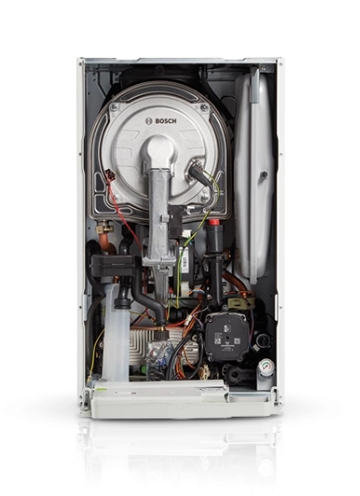
Technical Tear-Down: Specs, Flow Rates, and the 1:5 Modulation Problem
Claim: The 1:5 modulation ratio represents the primary mechanical limitation of the Worcester Bosch 1000, directly undermining its operational efficiency when paired with modern, low-heat-loss structural profiles.
Evidence: Mathematically, the 24kW variant bottoms out at a minimum space-heating output of 4.8kW. When installed in small, low-heat-loss flats or highly insulated properties where the true design heat loss typically sits between 1.5kW and 3kW, the boiler cannot modulate low enough to match the actual load. This structural mismatch forces the appliance to overshoot its flow temperature set point rapidly, causing chronic short-cycling. This behavioural loop accelerates mechanical component wear, increases structural gas consumption, and disrupts system equilibrium.
On the domestic hot water (DHW) side, production is strictly bound by the platform's plate heat exchanger constraints, manifesting as modest flow capacities across both available models:
| Boiler Specification | DHW Flow Rate @ 35°C ΔT | DHW Flow Rate @ 40°C ΔT | Minimum Modulated Output |
| Greenstar 1000 – 24kW | 9.8 L/min | 8.5 L/min | 4.8 kW |
| Greenstar 1000 – 30kW | 12.0 L/min | 10.8 L/min | 6.0 kW |
Because the physical gas valve hardware cannot natively modulate below these minimum kW thresholds, the installing engineer must range-rate the central heating maximum output down via the PCB parameters during commissioning. Artificially restricting this maximum space-heating capacity, when combined with high-quality weather compensation controls, forces longer burner run times and lowers system return temperatures, optimising condensing performance despite the narrow modulation envelope.
The Stainless Steel Heat Exchanger: A Double-Edged Sword for Retrofits
Claim: While the Worcester Bosch 1000's transition to a stainless steel heat exchanger provides excellent long-term corrosion resistance and tolerance to varying water chemistry, its compact design features significantly narrower waterways that introduce acute vulnerabilities during legacy system retrofits.
Evidence: Older open-vented or gravity-fed systems house decades of accumulated black iron oxide (magnetite) and suspended particulate sludge. When a tightly wound stainless steel coil replaces a highly tolerant, wide-waterway cast aluminium block, these dense thermal deposits rapidly drop out of suspension within the primary heat exchanger's high-temperature zones. This localised restriction quickly starves the primary circuit, creates localised boiling hot-spots, and leads to severe thermal stress or premature component failure.
To mitigate this operational risk, installing engineers cannot rely on simple system drain-downs. Executing a comprehensive central heating Magnacleanse flush is mandatory to clear the existing pipework down to bare metal before commissioning. This process must be paired with an industrial-grade magnetic dirt separator on the return leg and a high-performance chemical inhibitor regime. Without these baseline preventative measures, the tight hydraulic profile of this budget-friendly appliance becomes an immediate structural liability on older system cross-overs.
Worcester 1000 vs. 4000: Where Did They Cut Costs?
To drag a Worcester Greenstar boiler under the sub-£900 supply threshold, the manufacturing budget was explicitly gutted. While it retains the brand badge, comparing the entry-level 1000 directly to the mid-range 4000 exposes exactly where materials and engineering were stripped back to save capital.
The primary cost-cutting measures include:
- The Guarantee Drop: The out-of-the-box manufacturer protection drops from a robust 10-year guarantee on the 4000 down to a standard 5-year limit on the 1000, signalling a clear shift in expected mechanical lifespan.
- No Native Rear Pipe Access: The 1000 features zero built-in depth for vertical pipe drops behind the unit. If you are running pipework down the back wall, you are forced to buy and mount an external 50mm standoff bracket, increasing the installation footprint.
- Plastic Hydroblocks: While the 4000 retains brass components where high hydraulic stress occurs, the 1000 relies heavily on composite plastic internals. These plastic hydraulic blocks are far more vulnerable to thread stripping, chemical degradation from poor water treatment, and thermal stress cycles over time.
If your budget allows for the upfront premium, evaluating the Worcester Bosch 4000 combi is highly recommended for its superior longevity and higher-grade internal component architecture.
FAQ
| Does the Worcester 1000 require a stand-off bracket for rear pipework? Yes, unlike the 4000 series, the Worcester 1000 does not have space for rear pipe routing out of the box. If pipes are dropping behind the boiler, you must install an optional rear spacer frame, which adds 50mm to the boiler's 285mm depth. |
| Why is the Worcester 1000's 1:5 modulation ratio a potential issue? A 1:5 modulation ratio means the 24kW model can only dial its output down to roughly 4.8kW. In highly insulated or small flats with a low heat loss requirement, the boiler cannot fire low enough, leading to rapid short-cycling, which accelerates wear on the PCB and ignition components. |
| Is the stainless steel heat exchanger in the Worcester 1000 better than aluminium? While stainless steel offers superior corrosion resistance in hard water areas compared to aluminium, its internal waterways are narrower. When retrofitting the 1000 onto an older heating system, failure to thoroughly flush the system can lead to rapid blockages from existing magnetite sludge. |
| What is the true hot water flow rate of the Worcester 1000 30kW? The 30kW model delivers 12.3 litres per minute at a 35°C temperature rise. However, during winter when incoming mains water is colder, requiring a 40°C rise, the flow rate drops to 10.8 litres per minute. |
| Can the Worcester 1000 heating output be range-rated? Yes. During commissioning, the installing engineer can and should range-rate the central heating output down via the PCB settings to match the specific heat loss of the property, improving efficiency and reducing burner cycling. |